
Reframing difference and reclaiming our narrative
I want to talk about the importance of language and the words we choose when we talk about people, and why I chose the name Neuroextraordinary for my business.
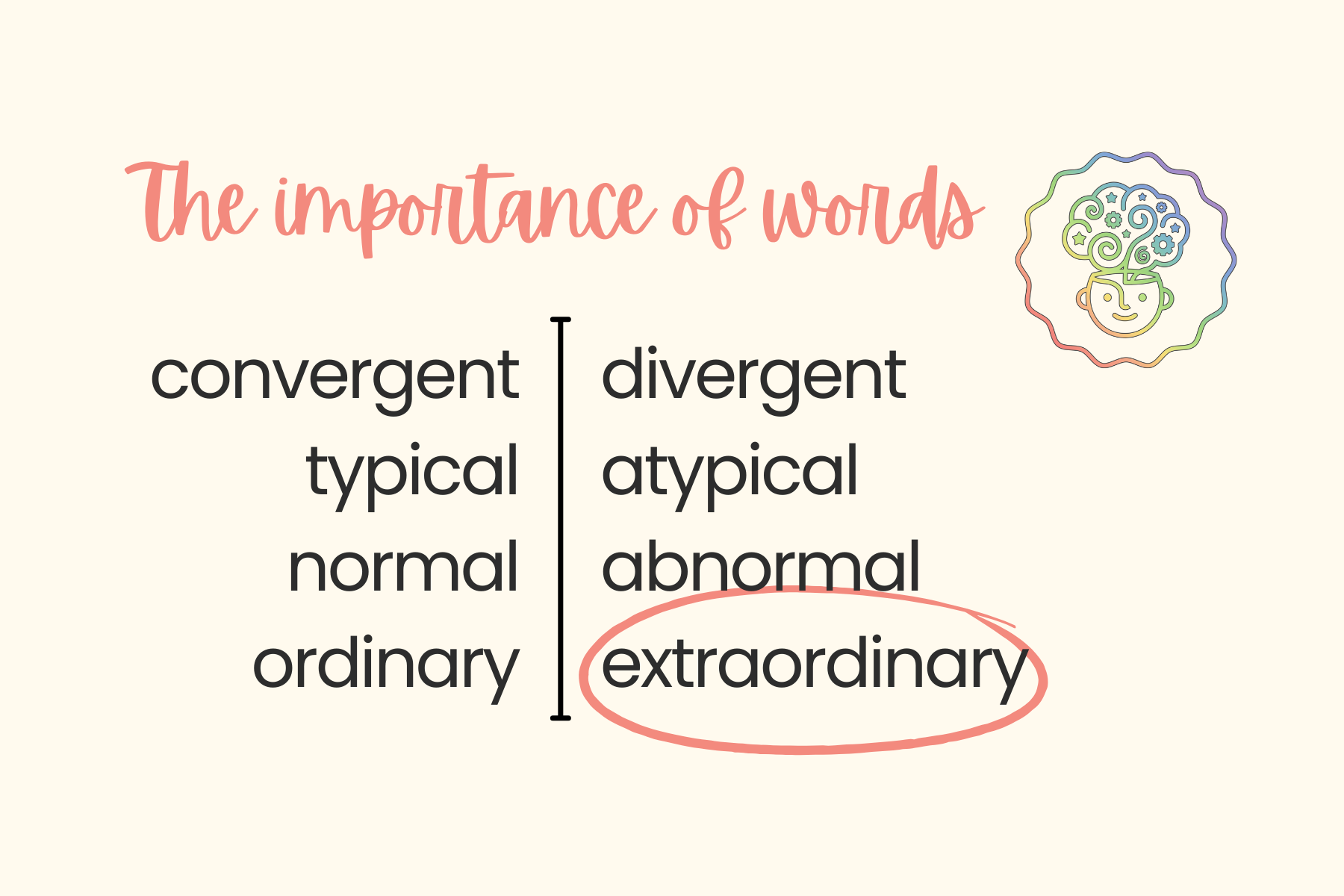
“The importance of words”. Convergent, typical, normal and ordinary are written on the left; divergent, atypical, abnormal and extraordinary on the right. Extraordinary is circled.
Take a look at these word pairs:
convergent / divergent
typical / atypical
normal / abnormal
ordinary / extraordinary
The words on the left are all synonyms for normal, signalling what’s considered average, expected, familiar, or occurring close together. The words on the right are their opposites.
If you’re up for it, I’d like you to try a small exercise.
I invite you to read through the words on the left first. As you read each one, notice the very first thing that comes to mind. It might be a feeling, an image, or a judgement. If you can, write it down. Then do the same with the words on the right.
Most people find that their responses to the words on the left are neutral or gently positive. They feel safe, acceptable, unremarkable. The words on the right, however, with the notable exception of extraordinary, often carry a different weight. They can feel othering, corrective, or quietly disapproving.
That’s because words don’t just describe things; they also carry sentiment. Some are socially rewarded. Others have been shaped into labels that imply deviation, incorrect or “not fitting in”.
As a neurodivergent person, I want to be clear about something. I’m not trying to gloss over how hard this can be. Living in a world that isn’t designed for the way my brain works comes with real challenges, exhaustion, frustration, moments of self-doubt, massive bills caused by my frequent costly mistakes. Those experiences are real, and they matter.
What I am trying to do is change the way I talk about those challenges, and about myself. I want language that allows me to acknowledge difficulty without defining myself by deficit.
That’s why I’ve chosen to stake a claim to extraordinary.
For me, it creates space for struggle and strength to coexist. It acknowledges difference without judgement. The meaning may sit alongside the other words on the right, but the sentiment is celebratory, rather than othering.
Because difference isn’t something we need to fix. It’s something to recognise, value, and celebrate.
